Why Choose Us
Factory Strength
Currently we have 2 full-automatic production lines and 4 manual production lines. Annual production is approximately 12 million pcs. Our management system is strictly conforms to IATF16949 quality certification system.
Production Market
Europe, North and South America, Asia, the Middle East.The Foreign Trade Department was established in 2011, and now customers have spread all over the world and won the praise of customers.
Provide OEM service
Provide customized services, including trademarks, product shapes, product parameters, etc.We can provide OEM service and help you with the R&D of new product and mould.
Our Certificates
Products passed CE, RoHS and UL certification, mainly sold to Japan, South Korea, Europe, USA, etc.
What is Cooling Fan
The primary function of the cooling fan is to regulate engine temperature by dissipating excess heat. Engines generate a tremendous amount of heat during operation, and if this heat is not managed effectively, it can lead to overheating and result in engine damage.While often overlooked, the cooling fan is a critical component in preventing your engine from overheating, which can damage the engine.
-
![5V DC Cooling Fan]() 5V DC Cooling Fan120x120x25mm dc fan is our key products, in order to meet various request for this fan, we have develop 3 molds for customer’s choose. Any request please don’t hesitant contact us!read more
5V DC Cooling Fan120x120x25mm dc fan is our key products, in order to meet various request for this fan, we have develop 3 molds for customer’s choose. Any request please don’t hesitant contact us!read more -
![Waterproof DC Cooling Fan]() Waterproof DC Cooling FanXYJ12B9225M 7 blades axial fan, waterproof dc cooling fan, outdoor IP67 dual ball bearing fanread more
Waterproof DC Cooling FanXYJ12B9225M 7 blades axial fan, waterproof dc cooling fan, outdoor IP67 dual ball bearing fanread more -
![Ip68 DC Cooling Fan]() Ip68 DC Cooling Fan9238 dc fan, voltage 12V-24V, current amp 0.12-0.63A, speed 2500RPM-5600RPM, airflow 47RPM-108CFM, noise level r 31-57dB-Aread more
Ip68 DC Cooling Fan9238 dc fan, voltage 12V-24V, current amp 0.12-0.63A, speed 2500RPM-5600RPM, airflow 47RPM-108CFM, noise level r 31-57dB-Aread more -
![High Temperature Resistance DC Cooling Fan]() High Temperature Resistance DC Cooling FanDC means direct current, DC fan is a fan whose input voltage is direct current. Generally used DC voltages are 5V, 12V, 24V, 48V and so on.read more
High Temperature Resistance DC Cooling FanDC means direct current, DC fan is a fan whose input voltage is direct current. Generally used DC voltages are 5V, 12V, 24V, 48V and so on.read more -
![RoHS Material DC Cooling Fan]() RoHS Material DC Cooling Fan50X50X15MM fan can do 5V,12V or 24V,and also the speed,air flow can be produced customized.read more
RoHS Material DC Cooling Fan50X50X15MM fan can do 5V,12V or 24V,and also the speed,air flow can be produced customized.read more -
![12V DC Coolng Fan]()
-
![Cooling Fan 12V DC]() Cooling Fan 12V DCUnless otherwise specified, all the fans of the measured data at room temperature does not exceed the rated voltage range ± 0.1VDC conditions measured.read more
Cooling Fan 12V DCUnless otherwise specified, all the fans of the measured data at room temperature does not exceed the rated voltage range ± 0.1VDC conditions measured.read more -
![Ball Bearing Cooling Fan 12V]() Ball Bearing Cooling Fan 12VOur company was established in 2006 and has been renting a factory in Shenzhen. In 2020, we purchased our own factory in Zhongshan. After the renovation is completed in 2022, the workers and equipment will be moved to the factory inread more
Ball Bearing Cooling Fan 12VOur company was established in 2006 and has been renting a factory in Shenzhen. In 2020, we purchased our own factory in Zhongshan. After the renovation is completed in 2022, the workers and equipment will be moved to the factory inread more -
![Sleeve Bearing Cooling Fan 12V]() Sleeve Bearing Cooling Fan 12VThis round fan is customized by us according to the customer's requirements. The customer's product is PAR light, which requires the fan to be round and with four legs. So far, many large products have been produced, and the customer'sread more
Sleeve Bearing Cooling Fan 12VThis round fan is customized by us according to the customer's requirements. The customer's product is PAR light, which requires the fan to be round and with four legs. So far, many large products have been produced, and the customer'sread more -
![Humidifier Cooling Fan 12V]() Humidifier Cooling Fan 12VInsulation Resistance:Input 500VDC between the frame and positive electrode wire, the resistance not less than 10MΩ.read more
Humidifier Cooling Fan 12VInsulation Resistance:Input 500VDC between the frame and positive electrode wire, the resistance not less than 10MΩ.read more -
![IP67 Converter Cooling Fan 12V]() IP67 Converter Cooling Fan 12VCompact structure : The rotor blade of the outer rotor fan rotates outside the stator. This design makes the fan structure more compact, saves space, and achieves the advantages of compactread more
IP67 Converter Cooling Fan 12VCompact structure : The rotor blade of the outer rotor fan rotates outside the stator. This design makes the fan structure more compact, saves space, and achieves the advantages of compactread more


Benefits of Cooling Fan
High-efficiency
The two cooling systems are air cooling via the computer cooling fans or the liquid complex systems, are counterproductive. These have a high thermal conductivity which means the heat diffusion through the various components is at a higher rate. Both liquid or air cooling let your systems operate at an optimally cool temperature that is consistent. A fan typically only kicks into gear as the computer overheats.
Faster CPU and GPU performance
Internal fans used in PC or laptops support faster speeds for improved overall performances. Internal system fans are connected to the CPU or GPU heat sink. The two biggest heat-producing components produce enough heat that puts the systems at risk of damage due to overheating. Cooling systems(i.e. Fans connected internally) produce enough heat to cope with the faster computer hardware that tends to produce more heat thus saving the systems from damage.
Lowering ambient temperatures
The computer operating temperatures are affected by the environmental or ambient temperatures that might deteriorate the working conditions in which the systems work. The rise in the temperature that accumulates around the device tends to be the main cause of disruption due to overheating. Here devices including the laptops have external cooling pads equipped with cooling fans that keep the ambient temperature down without requiring any modifications to the device’s hardware.
Improve airflow and allow streamlined cooling
The cooling systems deployed in modern-day technology bring into focus the right kind of airflow streamlining. The positioning of these cooling systems on a hard, flat, or non-fabric surface tends to cool the enclosure systematically. The use of the four walls of the device for an air-intake source cools the systems obstructing the flow that could prove hazardous. This process of the hot air regulation and replacement with the cooler one proves significant in driving the best working conditions in and around the PCs.
Types of Cooling Fan
Axial flow fans
Axial fans are a type of cooling fans, and the impeller of the axial fan pushes the air to flow in the same direction as the shaft. The impeller of an axial fan is similar to a propeller. When it works, the vast majority of gas flow is parallel to the axis, in other words along the axis.
Centrifugal fans
When a centrifugal fan is used, the impeller pushes the air to flow in an orientation perpendicular to the axis. The intake air is in the axial direction, and the out air is perpendicular to the axial direction. In most cases, cooling can be achieved by applying an axial fan. However, sometimes if the gas flow needs to be rotated 90 degrees or more air pressure is required, a centrifugal cooling fan must be applied. Strictly speaking, the cooling fan is also a centrifugal cooling fan.
Mixed-current DC cooling fans
Mixed-flow cooling fans are also called oblique-flow cooling fans. At first glance, mixed-flow cooling fans are no different from axial-flow fans. In fact, the inlet of the mixed-flow cooling fan is along the axis, but the outlet is oriented diagonally between the axis and the vertical axis.Since the impeller and casing of this cooling fan are called conical, the air pressure is higher. Under the same size and other comparable performance, the noise of centrifugal cooling fans is lower than that of axial fans.
Cross-flow DC cooling fans
Tubular airflow creates large-scale airflow and is often used to cool large-scale surfaces of equipment.The inlet and outlet of the DC cooling fan are perpendicular to the axis. The cross-flow cooling fan uses a relatively long barrel-shaped cooling fan impeller, and the diameter of the barrel-shaped fan blade is larger. Due to the larger diameter, a lower speed can be applied on the basis of ensuring the entire natural ventilation, reducing the noise caused by high-speed operation.
Application of Cooling Fan
Low power equipment such as routers and telecom receivers are housed in UL Type 12, 1 or 3R enclosures since they have no mechanical moving parts and are not susceptible to damage by deposition of dust or dirt on their shells. Cabinet cooling fans are well-suited to remove the low heat dissipated by this equipment.
Variable frequency drives for small compressors used in clean floor applications such as laboratories can be easily cooled by cabinet cooling fans. Filtered fans can handle a small amount of particulate matter in the air. Both metal and plastic filtered fans have easily removable grilles facilitating easy cleaning and replacement of filters.
Data servers and their accessories such as network switches and routers for a small organization can be cooled by a cabinet cooling filtered fan if they are located indoors and not exposed to humidity and contaminants in the air. As the size of the server racks increase, more cooling fans can be added to the enclosure to aid in efficient cooling.
Cabinet cooling fans can deliver spot cooling required for most Surge-protectors, Uninterrupted Power Supplies and switches. Positioning a cooling fan in the enclosure over the central transistor bank in these devices ensures that the source of heat dissipation is always exposed to convective heat transfer. Hot spots can be avoided by using internal circulating fans that mix the air in the enclosure.
Media equipment such as AV receivers, entertainment consoles, and antenna substations typically dissipate low to moderate heat. They are mostly housed indoors in a UL type 1 enclosure that facilitates the use of a cabinet cooling fan.
Industrial control panels for large machinery have a large number of switches, transistors and junction boxes that dissipate a lot of heat. Cabinet cooling fans can be used to remove the heat from these systems. In case a single fan is not able to provide the CFM required for heat dissipation, a bank of fans can be used for cooling. The modularity of cooling fans makes it easier to adapt them to different applications.
Cooling Fan Components
Blade Assembly
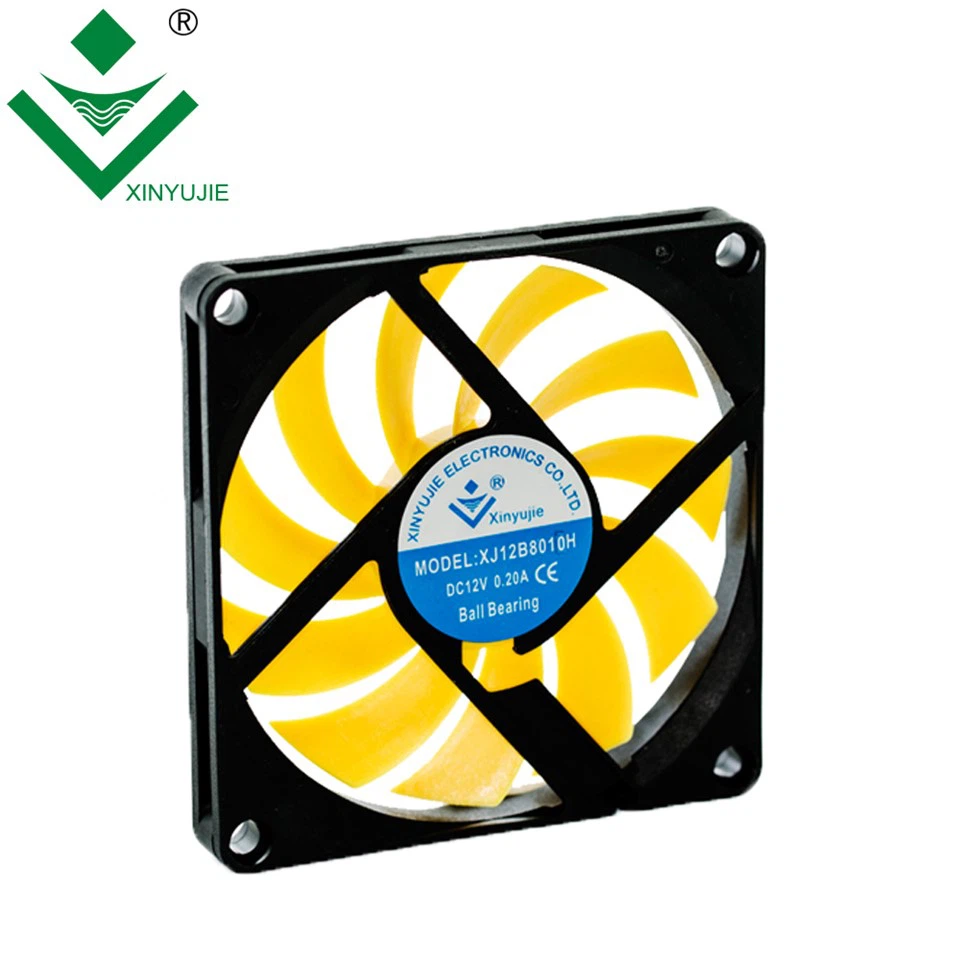
The blade assembly is a radiator fan’s primary (and most noticeable) component. It typically has arms that connect to a hub. The blades’ job is to force air through the radiator core when the fan is operating. The amount of air moved by the blades is often measured in CFM or cubic feet per minute.
Motor
Only electric radiator fans may use this motor, which is essentially a 12V DC motor. The motor’s function is to rotate the blades, generating airflow. One thing that makes radiator fan motor designs different is the size and shape of the motor. Even though the motor has a unique design, it still has all the standard parts.
Clutch
Only mechanical cooling fans use the clutch. It is typically a device that engages and disengages the fan. There are various methods to accomplish that, and the clutch can be either thermally or non-thermally actuated. Thermal cooling fan clutches are the most common type. To turn on the fan or let it run freely, they rely on a temperature-sensitive device.
Shroud
Nowadays, a lot of radiator cooling fans have a shroud. The metal or plastic shroud encloses the fan assembly. Its primary purpose is to prevent losses and direct air to the radiator. In this manner, the shroud contributes to the cooling fan’s increased efficiency. The radiator fan shroud can be divided into two pieces or one piece. The fan may come with it or be fitted independently.

Perform a Thermal Analysis
The first step in the cooling fan selection process is performing a thermal analysis. A thermal analysis determines the amount of heat generated inside a particular piece of equipment or during a particular process. The result can be used to calculate the volume of air needed to cool the device or system.Thermal analysis operations use sensors and other instruments to determine the source(s) of heat and the amount of heat generated by each source.
Determine the System Impedance
After the thermal analysis is performed and the required air volume is calculated, the next step in the cooling fan selection process is determining the system impedance. System impedance refers to the sum of the pressure drop experienced as air travels between the fan’s inlet vents and exhaust vents. If a system has multiple air paths, the individual impedance values are added. The value(s) can be measured for different rates of airflow with pressure sensors or by placing the system in an air chamber.
Choose the Type of Fan
After the system impedance is identified, it can be used with the calculated airflow requirement to gauge the static pressure needed for the system. This information can then be utilized to determine which fan will serve as the best solution.Cooling fans are divided into two categories based on the way air flows through them.
Final Considerations
In addition to the above, other considerations to keep in mind when choosing a cooling fan for a system include: Integrating speed controls: Fans that run continuously at fast speeds will wear out quickly. Integrating speed control elements that alter the speed of the fan when needed can significantly increase the overall service life of a unit. Incorporating performance monitoring circuits: Performance monitoring circuits track fan performance to identify potential malfunctions before they occur.
How to Replace a Cooling Fan
Step 1: Locate the Radiator Cooling Fan
Locating the radiator cooling fan is the first step in replacing it. Turn off your car and allow it to cool off. Open the hood of your car and you will be able to see the radiator that is located at the back of the grill at the front portion of your engine compartment. The radiator cooling fan is attached at the back of the radiator through a mounting frame.
Step 2: Disconnect the Power Supply
On the fan motor is an electric cable running towards the engine. Find the connector of the wires from your engine and from your radiator fan motor and disconnect it. Using two electrical tapes with different colors, note the connection of the wires so that you will not have a hard time reconnecting the wires later.
Step 3: Remove the Fan Housing
Using a wrench, remove the four screws located at each corner of the fan housing. Remove the fasteners at the sides of the fan housing as well. A radiator cooling fan housing is relatively large and you may need to remove all the obstructions like hoses and wirings so that you can extract the fan housing off your car. Hold the housing firmly and lift it out of your engine compartment. Be careful in removing the fan housing to avoid damaging it or the radiator. Place the fan housing on a clutter-free working table.
Step 4: Remove the Radiator Cooling Fan and the Fan Motor
The fan blade is either pinned or screwed to a shaft. With a screwdriver, loosen the fan blade and slide if off its shaft. You may need to remove a keeper that prevents the fan blades from moving up in the shaft up and down. As to the fan motor itself, remove it from the fan housing using a screwdriver.
How to Maintain Cooling Fan
Regular Inspections
Perform visual inspections of the cooling fan and its associated components as part of your routine vehicle maintenance:Check for visible wear or damage to the fan blades, shroud, and housing. Damaged blades can result in inefficient cooling.Inspect the electrical connections, wiring, and connectors for signs of wear, corrosion, or loose connections. Faulty electrical connections can disrupt the fan's operation.Ensure that the fan shroud is intact and properly secured. The cover helps direct airflow through the radiator and is essential for efficient cooling.
Cleaning
Keep the cooling fan and the surrounding area clean and free from debris, dirt, and insects. A clean fan and radiator maximize airflow, which is crucial for effective cooling. Use a soft brush or compressed air to remove debris and clean the radiator fins.
Professional Inspection
If you notice any symptoms of a faulty cooling fan or engine overheating, consult a qualified mechanic or technician for a thorough inspection. These professionals can use specialized diagnostic tools to assess the fan's functionality, including the temperature sensor and fan relay.
Regular Coolant Changes
Follow the manufacturer's recommendations for coolant changes. Over time, coolant can lose its effectiveness, leading to decreased cooling system efficiency. Frequent coolant changes help maintain the cooling system's performance and prevent corrosion.
Our factory
Shenzhen Xinyujie Technology Co., Ltd has been devoted to cooling fan manufacture and R&D since 2007. Our fan is involving in multiple fields such as 3D printer, Accumulator, Home appliance, Inverter, Greenhouse, Medical equipment and many other electric products.Our fan series are including DC axial fan, DC blower fan, AC fan, EC fan. Additionally, the fan could be customized according to your requirements for diversecurrent, voltage, speed, air flow, bearing type, cable and connector. Moreover, fan built-in optional function is available such as PWM, Tachometer, Alarm, Temperature control,reversing rotation , fireproof, waterproof (IP44-IP67) etc.

Certificate

FAQ
As one of the leading cooling fan manufacturers in China, we warmly welcome you to buy cheap cooling fan made in China here from our factory. All customized products are with high quality and competitive price.
-
![XYE-6025-PWM]()
-
![12038BK-K High Speed Dc Fan]()
-
![60X60X25MM DC Cooling Fan 24V 6025H24-K]()
-
![12032 Blower Fan For 3D Printer]()
-
![51X51X15MM Humidifier 5V 12V DC Blower Fan]()
-
![3D Printer Blower Fan 40X40X20MM]() 3D Printer Blower Fan 40X40X20MMThe 40X40X20MM blower fan is widely used for 3D printer,humidifier and so on.It's optional function ofread more
3D Printer Blower Fan 40X40X20MMThe 40X40X20MM blower fan is widely used for 3D printer,humidifier and so on.It's optional function ofread more