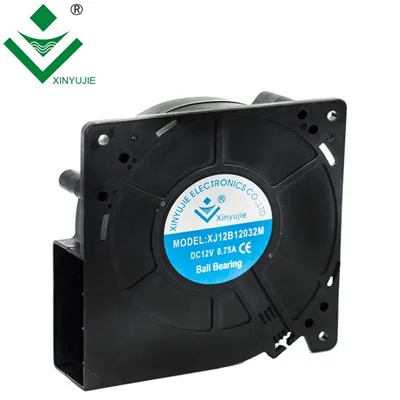
1. General knowledge of purchasing cooling fans:
When purchasing a fan, you should generally know the following necessary information:
★ The size of the fan.
★ Determine whether the fan is DC or AC.
★ The value of the fan's power supply voltage. For example: AC 220V, 110V, 380V. DC 5V, 12V, 24V, 36V, 48V.
★ The fan's bearing type, ball bearing or oil-containing.
★ The fan's air volume and speed. For example, how many cubic meters per minute, or how many cubic feet per minute.
★ Wind pressure value.
2. About bearings:
Oil-bearing bearings (Sleeve Bearing)
In the design of traditional DC brushless fan motors, the fan rotor (referred to as the rotor) and its shaft core pass through oil-bearing bearings, referred to as SLEEVE bearings, which are pivotally fixed at the center of the motor stator to maintain an appropriate gap between the rotor and the stator. Of course, there must also be a gap between the shaft core and the bearing to prevent the shaft core from being locked and unable to operate. After the power is input, the stator structure of the motor (referred to as the stator) will generate induced magnetic lines between the rotor and the stator, and the control of the drive circuit will make the fan motor operate. Therefore, the traditional fan motor structure has only one fan rotor, one motor stator and one drive circuit, and it operates with the pivot of the shaft core and the bearing with the magnetic field induction.
1. Advantages of using oil-bearing bearings
A. Resistant to external impact, less damage caused during transportation;
B. Cheap (the price difference is very large compared with ball bearings.
2. Disadvantages of using oil-containing bearings
A. Dust in the air will be sucked into the motor core due to the operation of the fan motor, and mixed with the lubricating oil stored around the bearing to form sludge, causing operating noise, or even stuck and not turning;
B. The inner diameter of the bearing is easy to wear and the service life is short;
C. It cannot be used in portable products;
D. The gap between the bearing and the shaft core is small, and the activation effect of the motor operation is poor;
E. The high-temperature gas generated by the friction between the motor shaft core and the bearing is blocked by the oil rings and washers at both ends of the bearing and cannot be eliminated, forming nitrides, which are easily blocked in the gap between the shaft core and the bearing, hindering the smooth operation of the motor.
Ball bearings (Ball Ball bearings use round metal balls to operate, which is point contact, so it is easy to activate and operate. In addition, ball bearings are used in conjunction with springs, so the spring supports the metal ring outside the BALLBearing, so that the weight of the entire fan rotor is located on the ball bearing, and is indirectly supported by the spring. Therefore, it can be used in portable products with different directions and angles, but it is still necessary to prevent it from falling, so as not to damage the ball bearing, causing noise and reducing its service life.
1. Advantages of using ball bearings
A. The operation of metal balls is point contact, so it is easy to activate and operate;
B. It can be used in portable products that are often operated at different placement angles and directions (but it is necessary to prevent it from falling or dropping);
C. Longer service life (compared with oil-containing bearings).
2. Disadvantages of using ball bearings
A. The bearing structure is quite fragile and cannot withstand the impact of external forces;
B. When the motor rotates, the rolling of the metal ball will produce a lot of noise;
C. The price is high and cannot compete with oil-containing bearings in terms of cost price;
D. The source and quantity demand of ball bearings are difficult to control;
E. Ball bearings use the elasticity of springs to position them, which makes them difficult to assemble.