

Installation size
CPU fans are mainly 60, 70, 80, 120 and even 140. What is the meaning of this model? We know that the outer frame of the CPU fan is a square, and its model is the side length of the square. For example, if the side length of the outer frame of a fan is 60 mm, the model is 60. In addition, fans are divided into thick and thin types, and all fans used by CPUs are thin. Fans of the same size are interchangeable. For example, the fans of Tt Volcano 9 and Coolermaster HV81 are both 80 types. You can remove the fan of Volcano 9 and install it on the heat sink of HV81 without any problems. There are also some specially designed fans that cannot be interchanged with other fans, such as the fan of Intel's original radiator, which is connected to the fastener and cannot be replaced.
Bearing type
It can be roughly divided into three categories: sliding bearings, ball + sliding bearings and double ball bearings.
Among the three types of bearings, sliding bearings have the lowest noise, but the shortest life and are more affected by the environment. Double ball bearings have higher noise, but longer life, and simpler manufacturing process, becoming the mainstream. Some improved sliding bearings have also appeared, which greatly extend their lifespan while maintaining low noise, and have become the favorites of some high-end radiators. Among them, the more excellent improved types include Sunon's magnetic levitation bearings and AVC's hydraulic bearings.
Blade shape
There are sickle-shaped, trapezoidal and AVC's patented folded edge type.
Relatively speaking, sickle-shaped fan blades are quieter when running, but the wind pressure is also smaller; trapezoidal fan blades are prone to generate larger wind pressure, but the noise is relatively larger. The folded edge type is the best design, which can generate larger wind pressure while maintaining low noise, but it appears less frequently.
Number of blades
The CPU fan blades are usually between 6 and 12.
Generally speaking, a smaller number of blades is more likely to generate larger wind pressure, but the running noise is also larger; while a larger number of blades is just the opposite.
Air outlet direction
It is divided into axial flow and centrifugal.
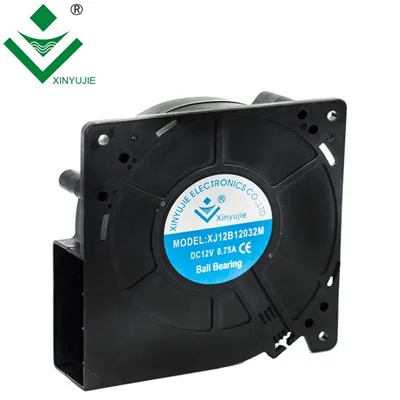
As the name implies, the axial flow type has air outlet along the direction of the fan axis, that is, perpendicular to the blade rotation surface; the centrifugal type has air outlet in all directions along the radial direction of the blade rotation surface. CPU radiators basically use axial flow fans, and only Coolermaster's "Tornado" series uses centrifugal fans. From a practical point of view, the air outlet of the centrifugal fan cannot be fully utilized when it is working, but will increase the working noise, so it is not a good choice. However, radiators using centrifugal fans are easier to make very thin, so they are often used in some graphics card cooling systems.
Rotation speed
It can be roughly divided into two categories: strong type and silent type.
This classification method is not too strict, but for fans of the same size and type, wind pressure and noise are always two irreconcilable contradictions.
CPU fan specifications


Send Inquiry