

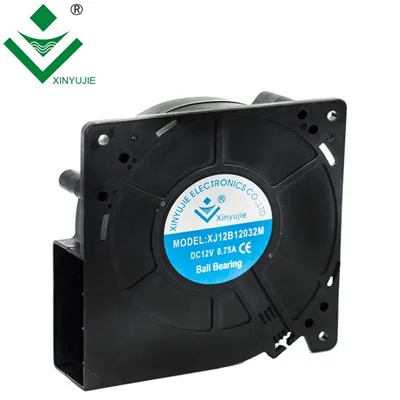
Another external manifestation of the quality of the fan is the noise level. Imagine that if the fan you bought is very noisy, even if the other performance of the fan is very good, you will not feel at ease, because too much noise will greatly affect our mood when operating the computer. The noise level is usually related to the power of the fan. Usually, the greater the power, the faster the speed. At this time, a negative effect is also manifested, that is, noise. Therefore, when we buy a fan, we must listen to the noise of the fan. If it is too loud, it is best not to buy it; of course, the noise of the fan is not necessarily a problem of fan quality. It may also be that the fan shaft is not lubricated well, or the fan is not installed correctly. If this is the case, we'd better reposition the fan or add some lubricant to the fan shaft to ensure its good lubrication effect. Nowadays, fans have invested in some designs to reduce noise, such as changing the angle of the fan blades, increasing the lubrication and stability of the fan shaft, etc. When we use lubricating oil to lubricate the bearings, it is easy to cause the machine to overheat and freeze due to a short operation time. In severe cases, the movement may be burned out. For this reason, many good brands of fans have begun to use ball bearings, which use many steel balls as a medium to reduce friction. The characteristics of this ball fan are strong wind, long life and low noise, but the cost is relatively high. Only high-end fans can use it. For ordinary fans, although they are all called "bearings", they are just bushing bearings, which are composed of copper jackets and steel shaft cores, which are completely different from "ball bearings". In addition, the author would like to emphasize here that the rotation of the fan should be stable, otherwise it is easy to generate noise. Therefore, when we buy a fan, we must remember to check whether the fan roller axis is loose.
Fan shape
The fan shape we refer to usually refers to the shape of the heat sink that makes up the fan. Since the shape of the fan has a great influence on the air intake and exhaust, and the air intake and exhaust are directly related to the final heat dissipation effect, in a sense, the shape of the fan also has a certain influence on the working performance of the fan. Ordinary heat sinks are die-cast, and the common shape is just a "leek" shape with a few more blades. The heat dissipation effect of this heat sink is the most common. The higher-end heat sink is made of aluminum mold by lathe turning. The shape after turning is multiple columnar protrusions. This kind of heat sink is often used on high-end graphics cards and some foreign original CPUs (many foreign original machines do not use fans at all, only this kind of heat sink). There is also a fin-shaped heat sink, which is made by bending a thin aluminum plate. It looks like an accordion bellows. This kind of fin-shaped heat sink has a good heat dissipation effect. The more high-end is the vortex-type guide heat sink. This kind of heat sink is formed by die casting, the heat dissipation is dense, and it is tilted in a certain direction to help the air flow through. This kind of heat sink is used in the famous "turbo fan" and the original CPU cooling fan. For this indicator, the author recommends that you comprehensively check from the perspectives of the fan shape, fan size, blade design, and fan thickness. Usually, fans of different shapes will not have much impact on heat dissipation, but in comparison, the size of the fan plays a relatively large role in the heat dissipation of the chip.
Fan noise
Previous
Fan exhaust volume




Send Inquiry