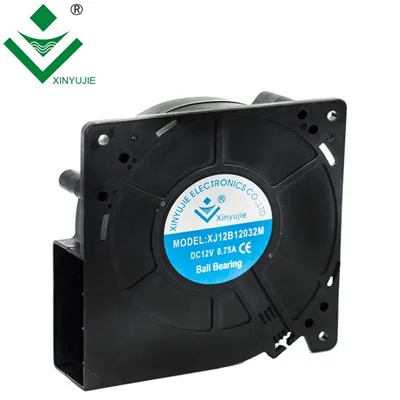
In fan applications, axial flow and centrifugal are the two most widely used types. We need to understand their similarities and differences so that we can make the right choice in fan selection according to our own use environment. The following is a brief introduction to the two types of fans.
The characteristic of axial flow fans is that the fluid flows along the axial direction of the fan blades. For example, electric fans and exhaust fans in homes. The centrifugal type is to suck the fluid from the axial direction of the fan and then use centrifugal force to throw the fluid out from the circumferential direction, such as blowers and range hoods.
Axial flow fan: large flow rate and small pressure head.
Centrifugal fan: large pressure head and small flow rate.
The airflow direction of the axial flow fan is perpendicular to the rotation direction of the blades, and the airflow direction of the centrifugal fan is tangent to the rotation direction of the blades.
The most important consideration for choosing a fan is the flow rate and system resistance loss.
Compared with axial flow fans, the biggest disadvantage of centrifugal fans is their large size. Because of their different structures, under the same air volume and air pressure, the power consumption of centrifugal fans is much greater than that of axial flow fans, but the noise is relatively small. Therefore, axial flow fans are mostly used in fire protection ventilation, and centrifugal fans are mostly used for fans in normal use. In high-end buildings such as hotels, many requirements give priority to the use of centrifugal fans.
Axial flow is the airflow in the same direction as the axis of the fan blade. Centrifugal, the airflow is thrown out by centrifugal force. The air flow direction is parallel to the axis, which is called an axial flow fan (such as a smoke exhaust fan for fire protection). Otherwise, it is a centrifugal fan (such as a fan coil fan).
The fundamental difference between axial flow fans and cabinet centrifugal fans lies in the mechanical structure of the fan:
The blade diameter of the axial flow fan is limited to the diameter of the outer shell, while the centrifugal fan has no such limitation. The blades can be tilted forward or backward, and the requirements for air volume and air pressure are more adaptable. Moreover, the cabinet can be treated with silencer, which has obvious advantages in noise index.
Because the motor speed is generally low, the motor power is large, and the power consumption is relatively high. If the ventilation system is usually used, try to use cabinet centrifugal fans. For systems that are not commonly used for fire smoke exhaust, it is more economical and reasonable to use high-temperature axial flow fans!
Centrifugal fans have more advantages than axial flow fans in the combination of large air volume and large air pressure (mainly referring to fan efficiency and noise index)!
The difference between centrifugal fans and axial flow fans is:
1. Centrifugal fans change the flow direction of the medium in the air duct, while axial flow fans do not change the flow direction of the medium in the air duct;
2. The former has large air volume and air pressure, while the latter has low air volume and air pressure;
3. The former is more complicated to install, while the latter is simpler to install;
4. The former motor and fan are generally connected by shaft, while the latter motor is generally in the fan;
5. The former is often installed at the inlet and outlet of the air conditioning unit, boiler blower, induced draft fan, etc., while the latter is often installed in the air duct or at the front end of the air duct outlet.